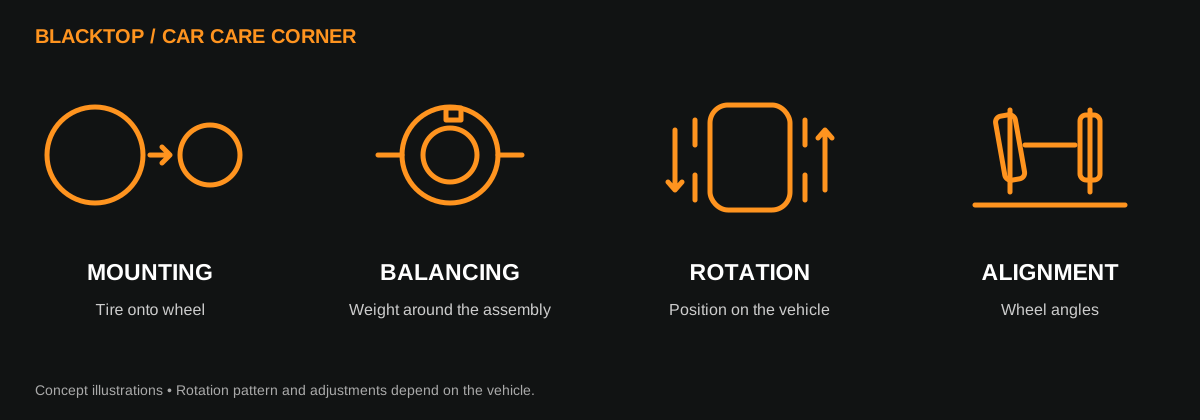
These terms often come up in the same conversation, but they aren’t interchangeable. Here’s a plain-language guide to what each service does.
Mounting: putting the tire on the wheel
The tire is the rubber part. The wheel is the metal part it fits onto. Mounting installs a tire onto a compatible wheel; replacing a tire also involves removing the old one.
Swapping a complete wheel-and-tire set onto a vehicle is different: the tires are already mounted on their wheels. That’s the kind of customer-supplied assembly swap we’ve featured from our shop.
Balancing: correcting weight distribution
A balancing machine checks the tire-and-wheel assembly. Small weights compensate for uneven weight distribution so it can rotate more smoothly. New or remounted tires generally need balancing.
A vibration can have several causes. Balancing may be part of the answer, but tire condition, wheel damage, and other vehicle components may also need inspection.
Rotation: changing positions
Rotation moves tire-and-wheel assemblies to different positions on the vehicle to help distribute wear. It does not normally mean removing the rubber tires from their wheels.
The correct pattern and interval depend on the vehicle and tire setup. Directional tires and different front/rear sizes can limit the options. Follow the vehicle and tire manufacturer’s guidance.
Rotation doesn’t correct an alignment problem or repair damage. If a tire is wearing unusually, the cause needs attention too.
Alignment: checking the angles
Alignment measures how the wheels sit and point relative to the vehicle and road. Available adjustments are made to the manufacturer’s specifications; not every angle is adjustable on every vehicle.
Pulling, an off-center steering wheel, or uneven wear can be reasons to ask about an inspection. Those symptoms don’t prove alignment is the only issue—tires and steering or suspension components can also play a part.
Which service do you need?
You don’t have to choose before calling. Tell us whether you’re replacing tires, changing a complete set, feeling a vibration, or noticing unusual wear. We’ll discuss the next step for your vehicle.
If the vehicle suddenly becomes difficult to steer or shakes severely, stop safely and arrange assistance rather than continuing to drive.
Have a question about your vehicle?
Call Blacktop at 620-345-2201 or send a request. Appointment availability is confirmed directly with the shop.
210 W. Cole St · Moundridge, KS 67107
Further reading: Michelin’s alignment and balancing guide · Michelin’s tire rotation guide
Also read: What to tell your mechanic ↗